
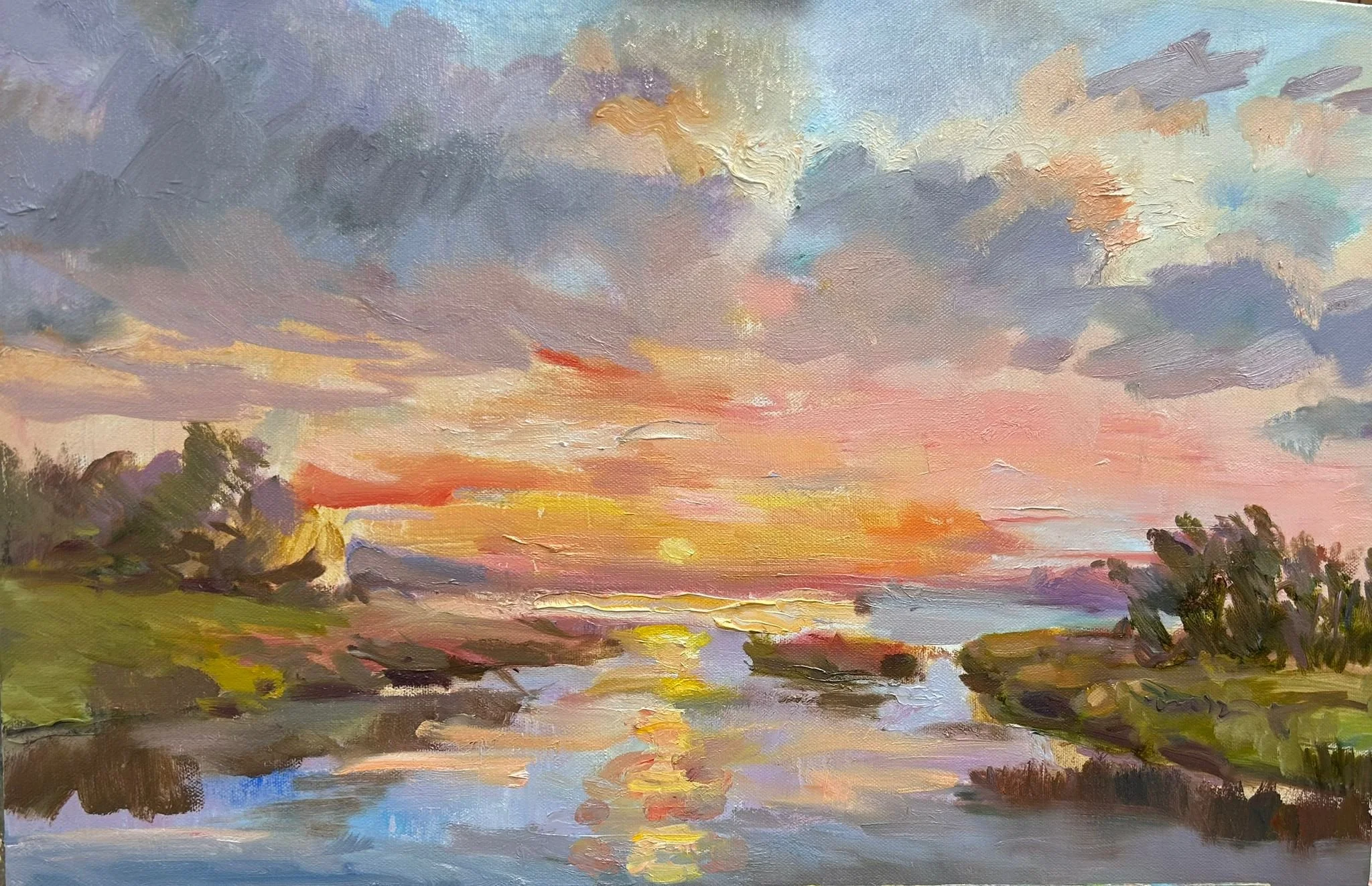
 Image 1 of 1
Maximum class size 8.
Easels, boards, chairs, and tables provided. Please bring your own painting materials - see list below.
Suitable for all levels. No experience in Landscape painting is required, but some basic experience in oil painting is needed.
Overview
This practical masterclass explores the essential principles and techniques of landscape painting in oils.
Participants will develop their understanding of composition, colour mixing, tonal values, atmospheric perspective and expressive brushwork.
Through demonstrations and guided exercises, they will learn to simplify complex landscapes, create a convincing sense of depth and light, and develop a more confident and personal approach to painting.
Course Programme
1. Landscape Observation and Composition
The session begins with observing and analysing the landscape. Participants learn to simplify the scene into large shapes and identify the foreground, middle ground and background. Through quick thumbnail sketches, they explore compositional balance, the horizon line, the focal point and the relationship between positive and negative spaces.
Techniques: Thumbnail sketching, shape simplification, visual observation and compositional planning.
2. Colour Mixing and Tonal Structure
Participants explore how to mix convincing landscape colours using a limited palette. The tutor demonstrates how to create natural greens, earth tones, atmospheric greys and subtle colour variations. Particular attention is given to tonal values, light and shadow, and the relationship between warm and cool colours.
Techniques: Limited-palette mixing, colour temperature, complementary colours and tonal studies.
3. Tutor Demonstration: Blocking In
The tutor demonstrates the initial stages of an oil painting, from establishing the composition to applying the first layers of paint. Participants observe how to organise the main colour masses, establish the sky and landforms, and create a strong underlying structure before introducing details.
Techniques: Initial drawing, underpainting, broad brushwork, colour blocking and establishing light and shadow.
4. Painting: Light, Space and Atmosphere
Participants begin developing their own landscape paintings with individual guidance from the tutor. The focus is on creating depth through atmospheric perspective, colour relationships and overlapping forms. They explore painting skies, distant hills, middle-ground features and foreground elements, learning how to suggest distance through changes in colour, contrast and detail.
Techniques: Wet-into-wet blending, directional brushwork, atmospheric perspective, layered colour and simplified forms.
Lunch Break
5. Refinement, Brushwork and Personal Expression
Participants refine their paintings by strengthening tonal contrasts, adjusting colour relationships and developing selected details. The tutor introduces different approaches to texture and mark-making, encouraging participants to use brushwork purposefully rather than overworking the surface. Attention is given to hard, soft and lost edges to create visual interest and guide the viewer's eye.
Techniques: Scumbling, broken colour, selective impasto, edge control and expressive mark-making.
6. Finishing, Group Critique and Feedback
The masterclass concludes with a review of the completed or developing paintings. Participants assess their composition, tonal structure, colour harmony and sense of depth. The tutor provides constructive individual feedback, while group discussion encourages reflection, shared learning and ideas for further development.
Learning Outcomes
By the end of the masterclass, participants will be able to:
· Simplify complex landscapes into clear compositional shapes.
· Mix convincing landscape colours using a controlled palette.
· Establish strong tonal relationships and atmospheric depth.
· Paint skies, distant features and foreground textures with greater confidence.
· Apply a range of oil-painting techniques, including blending, scumbling and expressive brushwork.
· Develop a personal approach to landscape painting and critically evaluate their own work.
The Tutor reserves the right to change timing if necessary.
Please contact us with any questions
🎨 Essential Materials for the Course
Surfaces:
One good quality canvas or canvas board 30x40 or 40x50, and one smaller canvas board 20x30.
Brushes:
Range of good quality hog for oil painting long filberts and flats from number 4 to 10
(long handle)
Oil Paints:
Cadmium Yellow
Yellow Ochre
Cadmium Red
Alizarin Crimson
Ultramarine Blue
Emerald Green
Phthalo Blue
Raw Umber
Titanium White
Other Materials:
· Sansodor (odourless solvent) Please do not bring turps or white spirit to the classroom.
· Palette: rectangular or oval medium wooden
· Winsor&Newton palette knife N21 or N22
· 2 jam jars with lids
· Kitchen roll
· Old shirt or apron to protect clothing (or wear old clothes)
· Small drawing pad A4
· Pencil, eraser